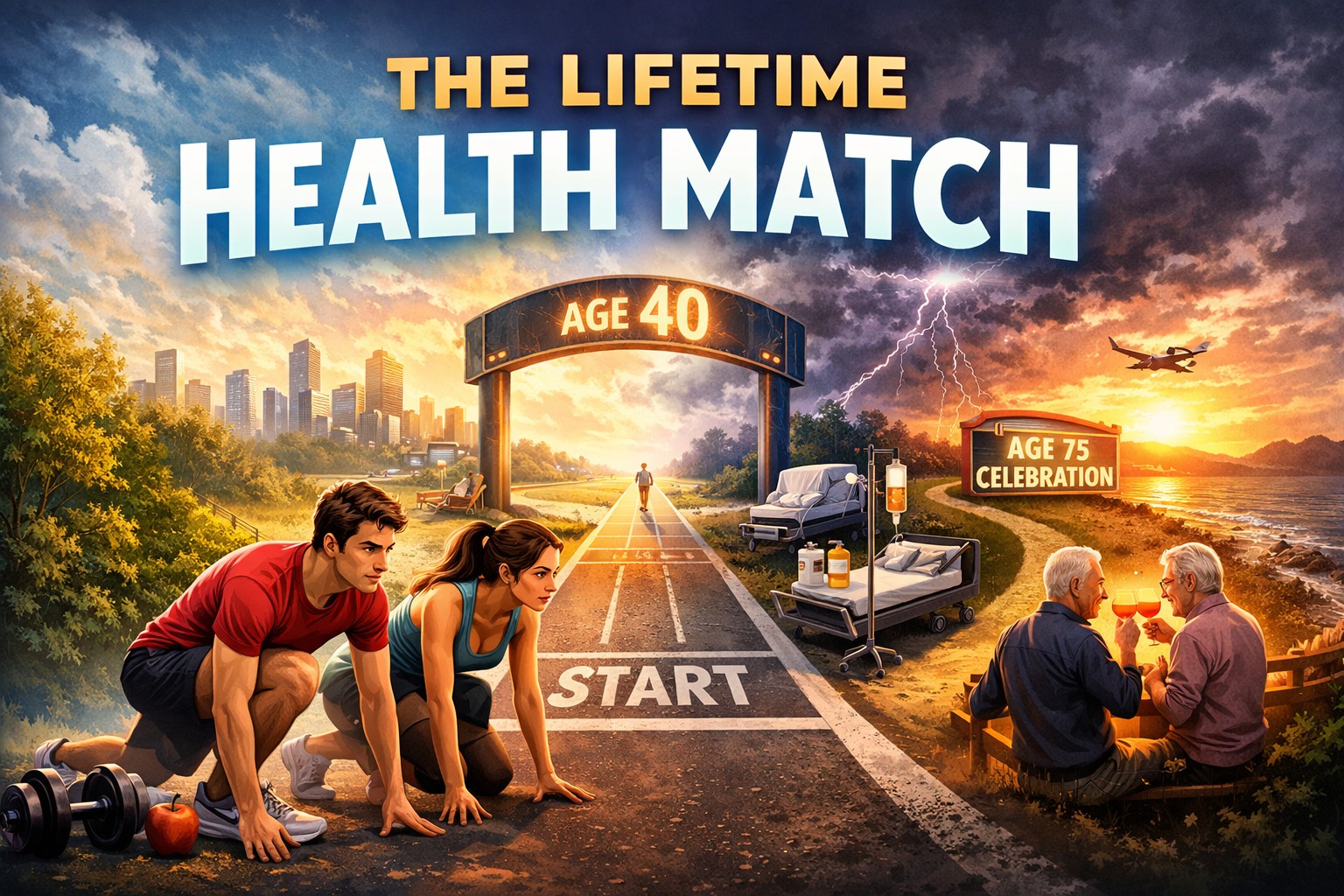
This message is for young people.
If you’re around 13 to 25 years old, you probably don’t think much about health. Most people don’t—unless someone close to them gets sick, or they grow up around doctors or hospitals.
But the truth is, these years are some of the most important years for your future health.
Let me explain it using a simple comparison.
Imagine that at age 40, everyone is required to enter a high-stakes match. There’s no option to opt out. And if you perform badly, the penalty is severe—in the worst case, it could even cost you your life.
If a tournament like that really existed, what would you do?
You would probably study the rules carefully.
You would train beforehand.
You would test strategies and try to prepare as much as possible before the match begins.
Yet in real life, many people enter that “match” completely unprepared.
One reason is simple: humans are bad at preparing for things they can’t clearly imagine.
When you are young, your body has incredible recovery power. If you make mistakes or push your limits, the damage usually doesn’t last long. You recover quickly. That means this period of life is the perfect time to experiment and learn about your own body.
Try different routines.
Learn what kinds of habits make you feel stronger.
Discover what helps you stay energetic, focused, and resilient.
During this stage, you have the opportunity to build your own winning playbook—the combination of knowledge, habits, and mindset that keeps you performing well while minimizing long-term damage.
People who use these years to figure out what works for them tend to move through the “health match” of midlife with far less struggle.
But people who drift through this period without thinking about their health often pick up harmful defaults: poor sleep habits, constant stress, lack of movement, unhealthy food as comfort, or the belief that health simply takes care of itself.
When the match begins—around age 40—things change.
Recovery becomes slower.
Damage accumulates more easily.
Problems that once disappeared quickly can start to stay.
Just like in most games, trying to learn the rules while already playing—and already injured—is much harder.
People who become seriously ill often say the same thing:
“I didn’t know. Nobody told me.”
Sometimes that’s true. Family, school, and society don’t always teach us these things well.
But the match doesn’t pause for explanations. It keeps going.
And when your body is already damaged, even trying harder can sometimes cause more harm than good.
This health game usually continues until around age 75. If you reach that point in reasonably good condition, the rest of life is almost like the after-party.
You can spend your time doing what you enjoy.
Travel where you want.
Eat and drink what you like.
Spend time with people who matter to you.
Whether that stage of life looks like sharing good wine with friends and laughing freely, or sitting with regret because your body can no longer do the things you hoped to do, is largely determined during the preparation phase you are in right now.
That’s something I hope younger people understand.
Because the preparation phase is already happening.
And the choices you make during these years have more influence on your future than you might think.