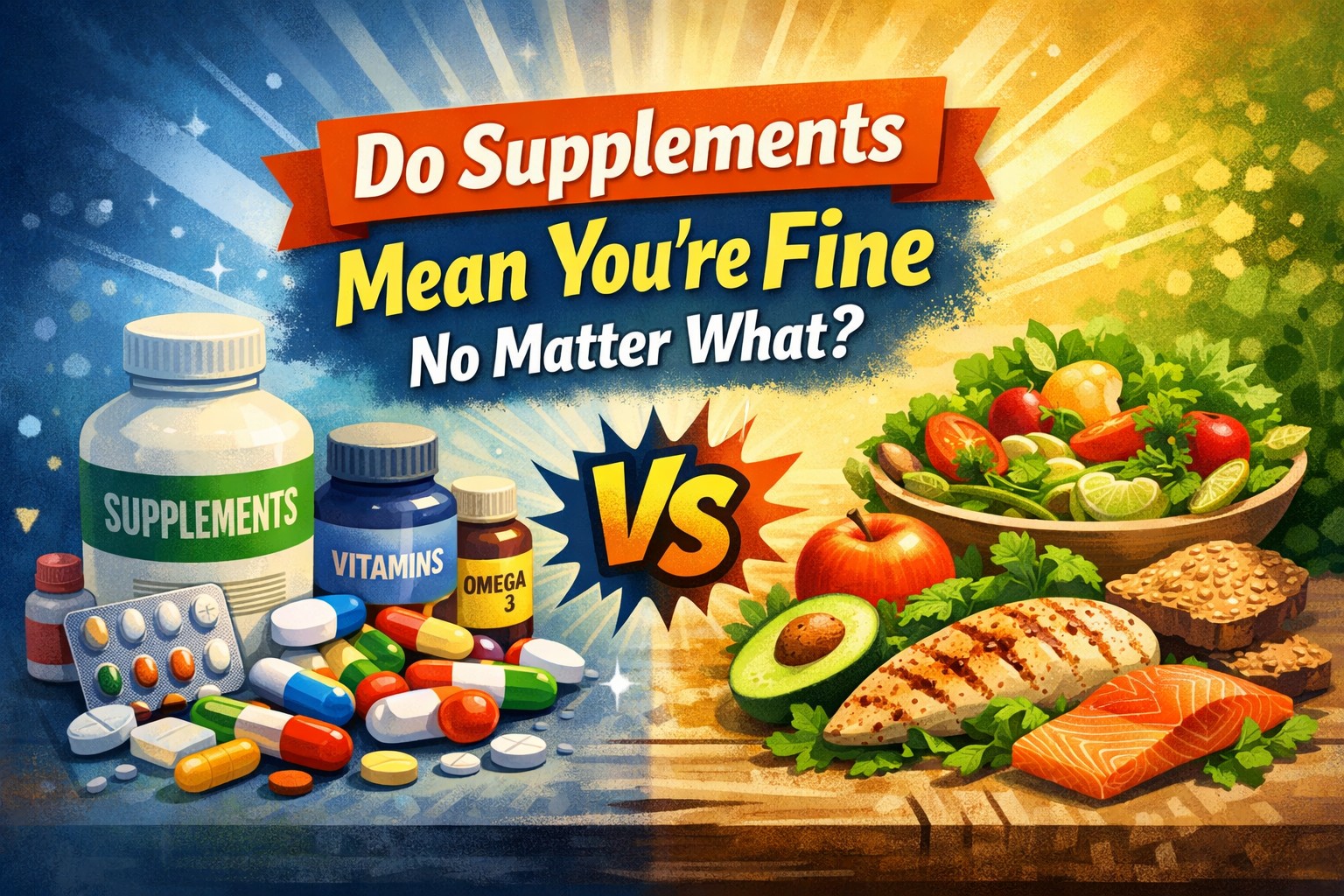
Supplements are, as the name suggests, meant to supplement nutrients you don’t quite get enough of from food. But some people take this idea much further. They keep actual meals to a minimum and rely on supplements for most of their nutrition.
Is that a problem?
It’s surprisingly hard to give a simple yes-or-no answer. Even people who claim to follow the same “supplement-heavy” philosophy often do completely different things in practice. The combinations, dosages, and overall lifestyles vary so much that it’s difficult to label the approach as simply right or wrong.
From a nutritionist’s perspective, the official advice is clear: eat a balanced diet first, and use supplements only to fill in the gaps.
Reality, however, is messier. Some people clearly harm their health with poor diets, while others seem to function just fine.
From a lazy-aging perspective—trying to maintain decent health with minimal effort—a life where most nutrients come from supplements probably won’t kill you. But it probably won’t make you feel amazing either.
Here’s why.
Most essential nutrients were discovered because someone became deficient and developed a disease. In other words, the nutrients strictly necessary for basic survival have largely been mapped out through history.
Because of that, if someone could perfectly match all required nutrients using supplements—getting the right amounts with no deficiencies or toxicities—they probably wouldn’t die from nutritional causes.
But that doesn’t mean we fully understand everything that affects how good the human body can feel.
There are countless compounds that don’t seem strictly necessary for survival but may still influence health in subtle ways: plant chemicals, fermentation products from gut bacteria, fiber metabolites, and many other minor bioactive substances.
These effects tend to be small and gradual. No one rushes to the doctor because their antioxidant intake is merely “suboptimal” or their gut microbiome diversity dropped slightly. As a result, research in these areas often relies on observational or ecological studies, and the accumulation of solid evidence moves slowly.
This is where whole foods have a major advantage.
Traditional diets are the result of centuries—really millennia—of human trial and error. Real food tends to deliver a complex package of nutrients and unknown bioactive compounds together. You get not only the vitamins and minerals we understand, but also a wide range of things science hasn’t fully figured out yet.
Of course, there’s no free lunch. Whole foods also come with extra calories, anti-nutrients, allergens, and plenty of compounds we might not necessarily need in large amounts.
Still, for now, food remains a remarkably efficient delivery system.
If someday we see true health obsessives—elite athletes, or maybe even long-duration astronauts—thriving for years on fully engineered, supplement-based diets, lazy-aging will happily follow their lead.
Until then, eating mostly real food and using supplements where they make sense seems like a reasonable compromise.
Not perfect.
Just good enough.